

← All projects
Digital Advertising Web Development UI/UX Design E-Commerce Consulting
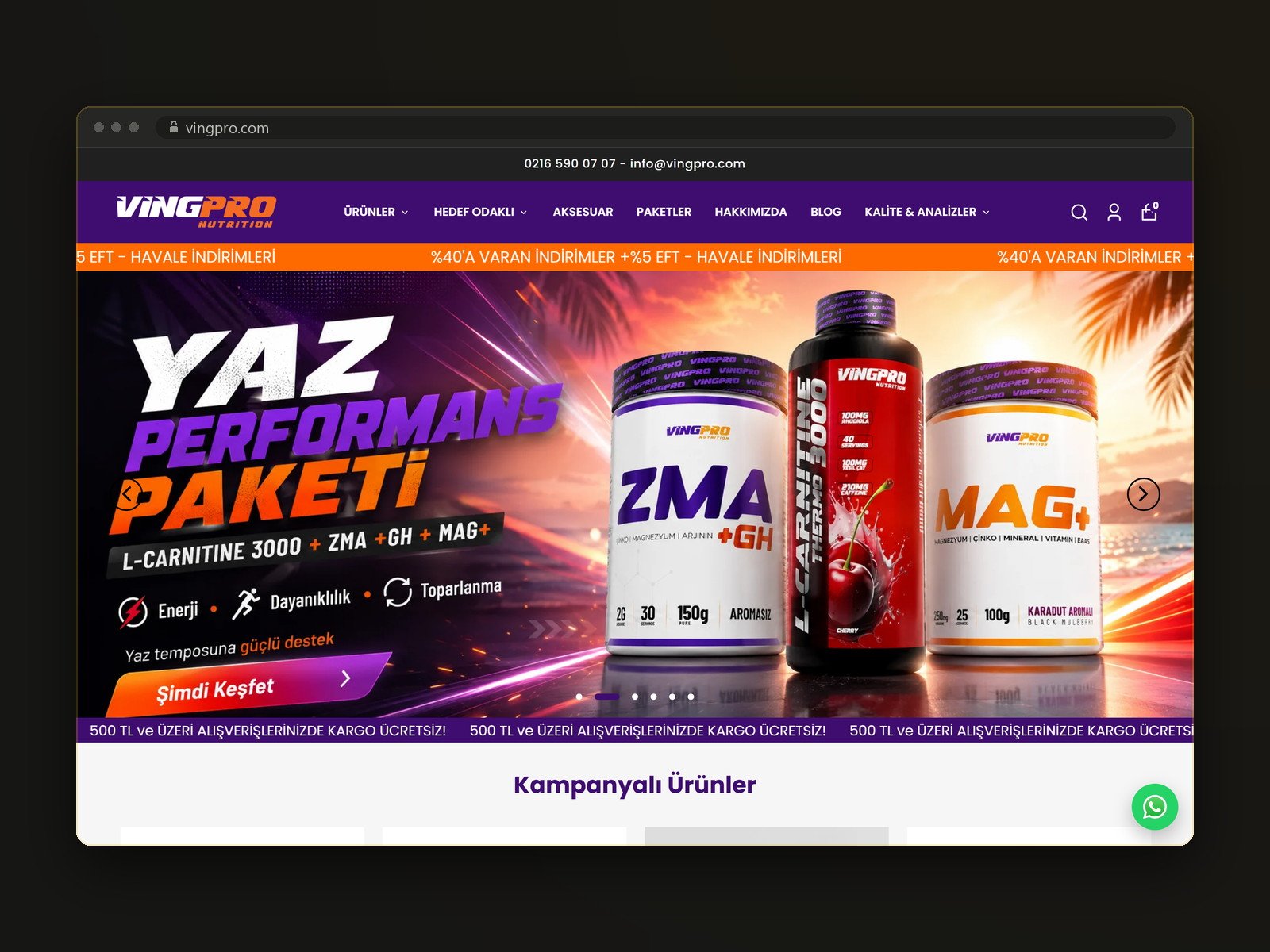
VingPro Nutrition — E-Commerce Site, Store Management and Meta Ads
Client
VingPro Nutrition
Year
2026’dan beri
Scope
E-commerce · Store management · Meta ads
Duration
Ongoing
Live
Request / Brief
In supplement sales, most visitors don't know a product name, they know their goal: gaining weight, burning fat, building endurance. The store was to be designed around that behaviour — a structure that doesn't leave a visitor who doesn't know what to buy alone with a product list. The second issue was trust: in this category, content and analysis information directly affect the purchase decision. Alongside the store, the scope also included Meta ad planning and ongoing store management.
Work done
In supplement sales, most visitors don't know a product name, they know their goal: gaining weight, burning fat, building endurance. The store was built accordingly.
E-commerce — Products can be browsed by the brand's own categories as well as by goal; there are also ready-made bundles, so a visitor who doesn't know what to buy reaches a combination in one click. Seasonal campaigns rotate on the home page, and the free-shipping threshold is visible on every page. Store management runs continuously, covering products, campaigns and stock.
Web — The store infrastructure was set up and the category architecture was built on two axes: brand category and goal. Product analyses were structured as a separate section; in this category, content directly affects the purchase decision.
Interface — Goal-oriented navigation is not just a menu heading but the backbone of the design: on the first screen the visitor is guided by the question "what do I need?" and isn't left alone in a product list. Trust elements — analysis, content, certification information — were placed on the product page close to the moment of decision.
Ads — The campaigns were built as a three-layer funnel, and each layer has its own measure. At the top (TOFU), video was shown to an audience that doesn't know the brand at all; the goal here is not sales but understanding what the product is for. In the middle (MOFU), the product was shown to the audience that watched the video and browsed the site, and the measure was add-to-cart. At the bottom (BOFU), a direct sales campaign was opened for those who added to cart but didn't buy, and for previous buyers. The layers feed each other: the top layer produces the audience of the bottom layer, which is why the budget isn't piled onto a single campaign.
In addition, product launches and campaign periods (whey, thermogenic, muscle recovery bundle) ran with their own campaigns; for products that need consultation, such as weight loss, the flow was tied to messaging rather than sales — in this category people ask before they buy. By setting up the product catalogue and conversion measurement, it became possible to track which target group converts to which bundle.
Deliverables
- E-commerce store setup
- Goal-based shopping architecture (weight gain · fat burning · endurance)
- Ready-made product bundles
- Product analyses and quality section
- Seasonal campaign home page layout and free-shipping threshold
- Ongoing store management — products, campaigns and stock
- Three-layer ad funnel: TOFU video views · MOFU add-to-cart · BOFU purchase
- Product launch and campaign period planning
- Messaging flow for products that need consultation
- Product catalogue connection and conversion measurement
Outcome
Between January and July 2026, ₺135,628 was spent in the Meta ad account; 1,142,872 people were reached, with 3,706,313 impressions and 60,162 clicks.
For this spend, Meta's pixel measurement attributes 488 purchases and ₺766,798 in revenue to the ads; the reported return on ad spend (ROAS) is 5.66. The number of add-to-carts was 11,953.
The funnel worked layer by layer as follows: in the top layer, about 219,000 video views were obtained with ₺48,331 — ₺0.22 per view. In the middle layer, a cost of ₺15 per add-to-cart was achieved with ₺74,723. ₺64,794 was allocated to direct purchase in the bottom layer. For products that need consultation, over 200 direct messages were also opened.
The figures are Meta's own attribution measurement; sales coming from organic traffic and marketplace channels fall outside this measurement.


Let the next project be yours